

Do you wish at least one of your videos would go viral, boosting your engagements and increasing the number of followers you have in one go?
What if we told you there are ways to create viral content that have nothing to do with luck?
In this post, we share examples of the types of viral content you can create on social media and include tips on how to create it.
1. Prepare your social media accounts for going viral
Sometimes content with low-quality audio and video that was posted by accounts with little to no followers goes viral. These are the types of videos that rely on luck.
If you want to all but guarantee your chances of going viral and repeat the process, you need to work on your social media accounts so content can go viral.
Start by finding a niche within your niche if you haven’t already done so. Don’t just create content about gardening. Create content for indoor plants, operating a greenhouse or even caring for succulents.
There are plenty of other things you can do to improve your odds of going viral as well:
- Post on social media platforms your audience uses most.
- Improve your video and audio quality.
- Improve the way you present videos by being authentic. Also, loosen up a bit. Create content like you’re creating it for your friends, not your corporate boss.
- Post when your audience is active.
- Create a consistent posting schedule with a tool like SocialBee.
- Choose quality over quantity when it comes to posting frequency.
- Reply to comments on your videos, and leave comments on other videos in your niche.
- Provide value in your niche by presenting solutions to problems related to it.
2. Understand the types of content that go viral
There are six primary forms of content that go viral on social media. Viral content is content that…
- …plays on your emotions, whether they be joy, sadness, anger or shock.
- …is made to look beautiful or outrageous.
- …features someone reacting to something.
- …has a lot of value for a particular niche.
- …targets a particular trend.
Any one of these content formats can be used to make a viral video.
Let’s talk more about each one.
Emotionally-engaging content
This type of content feeds on the viewer’s emotion. It uses storytelling elements alongside sounds and visuals that depict the emotion you’re trying to evoke.
Here’s an example from @chikastagram_0425 on Instagram.

Chika is a young skateboarder, and in this video, she lands her first kickflip.
Her parents sing their praise, and her dad runs over to hug and pick her up as the entire family breaks out into tears.
As a viewer, you can’t help but feel joy for the little girl’s accomplishment and melt at the family’s loving dynamic.
In spite of the account only having 84,100 followers, the video earned 19.2 million views, 2.5 million likes, 23,300 comments, and 260,000 shares.
Content with stunning or shocking visuals
If you’re able to film or capture your niche in a way that captivates the eye, you have a much higher chance at creating viral content.
This is something TikTok creator @nilered does regularly.

In this particular video, he’s showing how differently a flame’s appearance can appear based on what chemical is burning.
The thumbnail depicts the white flame.
Overall, the video received 85.7 million views, 17.1 million likes, 89,200 comments, 1.1 million favorites and 229,800 shares.
React content
React content is content that features an individual or group of individuals reacting to something, be it a video, movie or something happening in real time.
It’s very simple to film, especially if you do it on TikTok where you’re able to film duets and stitches.
All you need to do is find a popular video in your niche, and record yourself reacting to it. You can also stitch it to share your thoughts on it instead.
This content format is especially effective if you’re an expert in your niche and have an infectious personality.
Here’s an example from @tarasimonstudios.

In this video, she’s reacting to a pair of store clerks from the Philippines singing karaoke quite beautifully.
This video received 13.2 million views, 887,600 likes, 7,261 comments, 62,900 favorites and 4,243 shares.
Value-heavy content
The best way to become an authoritative brand in your niche is by providing value within it.
When you create content that has a lot of value in it, you’re able to hold your audience’s attention for longer than you normally do.
If they find your video valuable enough, they may even share it.
This is something TikTok creator @kaymairecrochets has done.

She created a video in which she breaks down the basics of crochet for beginners.
There are a lot of videos like this on the web, but what stands out with her video is how slow she explains things and her willingness to repeat instructions.
Many hobbyists who are new to crochet often complain about the pace of tutorials being too fast.
Her video has resonated with beginners quite well as it’s received 3.2 million views, 360,200 likes, 3,665 comments, 168,700 favorites and 22,300 shares.
Trendy content
When social media trends occur, join in! Just do so in a way that relates to your niche.
Participating in a trend generally attracts all kinds of social media users, but if you get a little creative and tie your niche into a trend, you can also attract quite a bit of your target audience.
This is something @pbr (Professional Bull Riders) did on their TikTok account.

They used a viral sound from Love Island that says, “I feel like you’re just here for the zipline,” but the text overlay on the video says, “I feel like you’re just here for the cowboys.”
It then goes on to say, “we see your comments,” referencing raunchy comments made by viewers who aren’t into bull riding as much as they are into the men performing the sport.
The video has 2.1 million views, 469,000 likes, 1,561 comments, 31,100 favorites and 25,200 shares.
3. Keep your recording equipment handy
Sometimes viral content isn’t content that was planned, scripted and recorded meticulously. It’s an exciting experience that was captured in the moment.
It’s best that you keep your recording equipment handy because of this, even if it’s just your phone.
Whenever something outrageous or unexpected happens, whip out your camera, and capture it.
4. Start each video off with a hook
Engage your audience immediately by starting every video off with a hook that locks you in within the first three seconds.
Hooks can be questions, or you can show the result of what you’re presenting at the start of a video.
You can also play the most exciting part of the video at the start, then let the video play out like usual.
You basically want to come up with a way to captivate your audience as soon as they land on your video to prevent them from scrolling to the next.
5. Make shorter content
Tiktoks you record inside TikTok can be up to 10 minutes long, Instagram reels and YouTube shorts can be up to three minutes long, and Facebook reels have a maximum duration of 90 seconds.
And yet, the shorter you can make your content, the better.
TikTok’s maximum length per video was 60 seconds when the app became popular in 2020. This is still the maximum length you should use for most videos.
Explainer videos get a pass, especially if you’re trying to take things slow enough to prevent overwhelming beginners in your niche.
When it comes down to it, viral videos should be easy to consume, so try your best to make each video less than 60 seconds.
6. Create engaging captions
Some videos aren’t truly entertaining until the viewer reads the caption.
Many creators use their captions to summarize videos, but you’re much better off using them to provide more details or tell jokes.
For example, if you share a video of your cat doing something odd and they did it twice before you decided to record it and more times after, use your caption to say something along the lines of, “he did this 9 times.”
TikTok has ensured that the caption doesn’t get buried in a video’s UI. Other platforms have followed suit with their short-form video UIs.
So, be sure to work on making your caption more engaging.
7. Use hashtags and keywords
Some social media users find new videos by scrolling through hashtag results and regular keyword-based results.
This is why you should choose your hashtags and keywords carefully if you’re even choosing them at all.
That one share you receive by someone finding your video in this way could just be the thing that sets things in motion for your video going viral.
Use the search bar of the primary social media platform you upload to to determine which keywords and hashtags to use. These platforms provide suggestions as you type.
Some creators add trending hashtags to their content. Unfortunately, social media algorithms are getting smarter, so you may want to steer clear of this technique and use only relevant hashtags instead to avoid being “shadowbanned” by a particular platform.
8. Use trending sounds
When sounds trend on social media, viewers are able to scroll through it and see every creator that’s uploaded a video to a particular sound.
Most platforms sort these results by the number of views or engagements a video has received, so the quicker you can upload content to a sound, the better.
You can either use the sound as background noise for your video, replace the audio with it, or use it to participate in a trend.
If you upload similar videos around the same time, use the sound again to create somewhat of a “mini series” on your account.
9. Optimize by platform
TikTok videos can be up to 60 minutes long if you upload the video to the platform instead of using it to record the video. Facebook Reels, on the other hand, have a maximum video length of 90 seconds.
This is quite different.
Plus, some platforms don’t have an option for you to create carousel posts, and if that was the entire point of your original video, you won’t be able to upload it to that other platform.
Learn the ins and outs of each platform, and optimize your videos for them accordingly.
10. Plan collaborations regularly
Collaborations do a fantastic job of helping your content reach new audiences, helping you and your collaborator to go viral across multiple platforms.
Make a list of creators in your niche, creators in adjacent niches and creators you dream of working with.
Come up with a few video ideas, and pitch them to each creator. You can pitch different ideas to each creator if you’re worried about more than one saying yes.
Even if you think more than one will say yes, consider creating another mini series by creating the same type of content with other creators again and again.
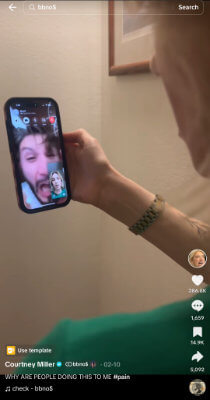
This is something artist and social media influencer bbno$ has done on TikTok to promote new songs.

His name is meant to be pronounced “baby no money,” but many have called him everything but, namely “bibinos.”
When he wanted to promote his song “check,” he launched a campaign that depicted him becoming angry at being called anything but “baby baby no money.”
This campaign included several collaborations with other creators.
Be sure to keep in touch with creators you collaborate with.
In fact, bbno$ created several videos with Smosh in 2024, which allowed him to collaborate with Smosh cast member Courtney Miller for his “it’s baby no money” campaign.
11. Analyze & optimize
The first video you try to make go viral might not go viral.
This is okay.
Social media thrives on consistency, so just keep doing what you’re doing for a while. But while you keep posting videos, use social media analytics to analyze them so you can optimize your content along the way.
Maybe you need a different hook to increase watch time. Maybe you need to rethink your strategy in order to increase the number of engagements you receive per video.
Tracking these metrics over time will help you succeed.
Final thoughts
Ok, so we’ve covered a bunch of ways you can increase the chances that your content will go viral.
Now, you might be thinking – what if I don’t have many followers? Surely that’ll be an issue right?
Here’s the good news:
Social media algorithms will recommend content from any account providing it gets enough engagement.
Get the content right and it won’t matter too much whether you have many followers or not. Social algos will push it.
In the past we have seen small accounts outperform accounts with 400K followers just because the content got more engagement.
Related reading:
- Proven Social Media Branding Strategies To Grow Your Audience
- How To Build A Social Media Marketing Strategy: Beginner’s Guide
- The Best Time To Post On Social Media (Guide To Popular Networks)
Disclosure: Our content is reader-supported. If you click on certain links we may make a commission.
