

Ever feel like your content takes forever to create… and still doesn’t perform?
You plan it, film it, edit it. Then it gets ignored.
Here’s the problem:
The more polished your content looks, the easier it is to scroll past.
Why? Because it looks like everything else.
There’s a different approach that’s working right now. It’s called anti-content.
In this post, you’ll learn how to use it to stand out, create faster, and get people to actually stop scrolling.
What is anti-content?
Anti-content is hard to define, at least cleanly. This is because it has many definitions.
Some label any content that’s intentionally harmful or hateful as “anti-content.” This includes violent content and content that contains racist, sexist or homophobic imagery and words.
On the other hand, “anti-content” is also used to describe content that’s low in quality or even intentionally bad.
Content that’s low in quality is part of an emerging trend called “lo-fi content.” Any content that’s raw and unedited falls under the umbrella of lo-fi content. Even content that’s filmed with a phone’s front-facing camera, the lowest-quality camera on most devices, falls under this label.
But like I said, anti-content includes content that’s intentionally bad.
This could be content that’s blurry, has poor audio quality, uses an awkward caption or just seems off in general. A post especially falls under the anti-content label if it has a tone that’s much different from the rest of your feed as well as the rest of that user’s content.
Note: I’m writing this article with the latter definition in mind. I highly advise against creating content that’s intentionally harmful or hateful. Not only will it lead to your content and account being restricted or outright banned on platforms, it’s a negative approach towards activism that will only lead to isolation.
Why is anti-content so effective?
According to data collected by Statista, social media users spend an average of just under two and a half hours on social media everyday.
That’s a full-length movie. And if users spend the majority of their time on a platform like TikTok, they’re primarily filling that two-and-a-half-hour window with short-form content.
That’s a lot of videos to consume on a daily basis.
What I’m getting at here is that social media users are very familiar with social media. They know what to expect when they scroll through their For You pages.
By creating anti-content, you shatter those expectations and get users to stop scrolling.
Let’s say you decide to take part in a dance trend, something you usually shy away from because you’re not a very good dancer and have very little rhythm.
You might feel as though you have no place in taking part in such a trend, but it’s actually quite the opposite. A dance trend video that contains sub-par dancing is just as likely to turn heads than a video made by a professional dancer, if not more.
As mortifying as it might be for you, watching someone fail is entertaining. It’s relatable and endearing and can even be shocking if a video depicts someone failing at something most of us are able to do easily.
Examples of anti-content
The dance trend video idea is just one example of anti-content.
Let’s discuss a few real-world examples.
Brittany Broski
The first example we’re going to cover is TikTok star Brittany Broski.
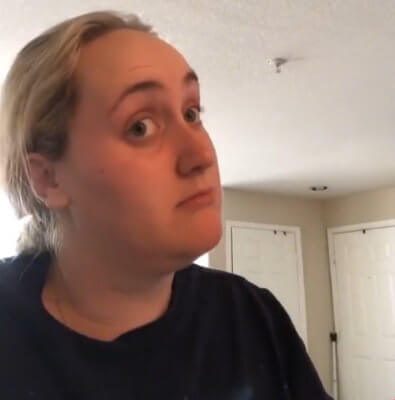
She originally became popular due to a video she created of herself reacting to kombucha for the first time.
For years, she was known only as her given meme name “Kombucha Girl,” but she has since overcome the memes well enough to craft a media empire in her own name.
She even has a show on YouTube called Royal Court in which she interviews everyone from fellow social media stars to famous celebrities like Cole Sprouse, Nicholas Hoult, Saoirse Ronan and Rob McElhenney.

Her original Kombucha Girl video is actually a form of anti-content itself, but what I really want to focus on are the differences between her main TikTok account and her spam account.
TikTok creators create what’s known as a “spam account.” This type of account is much more relaxed than their main accounts.
On a spam account, a TikTok creator can post whatever they want. A lot of creators use this type of account to publish behind-the-scenes content or unpublished drafts.
However, some, like Brittany Broski, use their spam accounts to post raw and unedited content that’s a far cry from the polished content they normally publish to their main accounts.
In Brittany’s case, the results are undeniable.
Although her main account has just under two million more followers than her spam account (7.6 million versus 5.9 million), her spam account has more likes (540.7 million versus 308.4 million).
Clearly, her off-the-cuff videos, some of which she intentionally films at unflattering angles for a better comedic effect, resonate more with social media users than videos on her main account, which are still quite casual, to be fair, but they’re a much different flavor of casual.
Wendy’s
It’s easier for a regular social media user to be more relaxed with their social media content. Unless they’re as popular as Brittany Broski has become, they’re not held to as high of a standard on social media as big brands are.
As anti-capitalist sentiments rise, social media users grow more and more tired of seeing brands, especially large, corporate brands, in their feeds.
Corporate social media content is far too professional most of the time. It’s corny in the worst ways and not at all engaging.
Sometimes it has value, but most of the time, it feels like an ad trying to pose as genuine social media content.
That’s an approach to social media that brands like Wendy’s and Duolingo have tried to stray away from.
Wendy’s strategy came first.
While most fast food restaurants scraped to get by on social media by announcing new menu items or discounts, Wendy’s had another approach: to break away from the mundane strategy of posting one promotional tweet after another by focusing on posting comedic content instead.
And that’s exactly what Wendy’s social media manager did.
Big brands already have notoriety, so when they do something that breaks form, social media users take notice immediately.
That’s what happened in 2016/2017 when Wendy’s social media strategy shifted from run-of-the-mill promotional tweets to straight-up roasts.
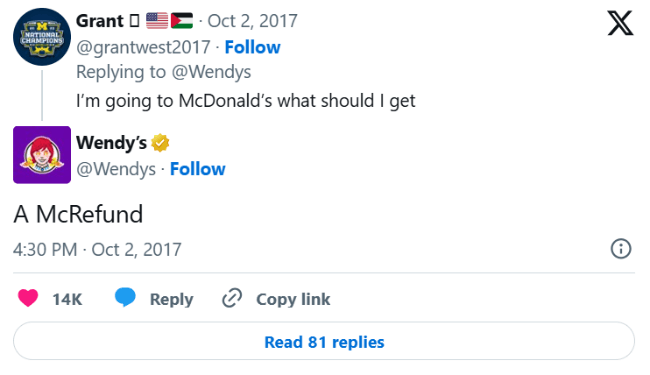
It’s a trend that continues to this day. Social media users even request to be roasted by the company.
It’s a strategy that has awarded the fast food chain with tens of thousands of likes on individual tweets, not to mention more of a social media presence.
Duolingo
Brands posting everything but content related to their product is a social media strategy Duolingo’s social media manager took notice of and eventually dominated.
Duolingo is an education app that helps you learn languages.
Around the time TikTok became popular worldwide, Duolingo started posting comedic videos with its mascot, Duo the owl.

Several versions of this mascot have appeared on Duolingo’s TikTok account, most notably a person wearing a large green owl suit.
The company started using this character to post meme-style content in every format you can think of. They took part in trends, collaborated with other famous figures, and did their best to outdo themselves with each and every new video.
Some of their videos have tens of millions of views. Overall, they’ve received over 16 million followers and 456 million likes.
Although the company’s CEO has decimated the app’s brand image by announcing an AI-first approach strategy, there’s no denying the immense success the brand has had by focusing on content that’s more funny and less polished.
Why anti-content is good for your social media strategy
Social media is hard for a lot of us. We spend hours coming up with ideas and planning out content.
We write scripts, and spend endless hours sifting through footage and editing it all together until it’s pristine and ready to be viewed by others.
But the truth about social media is that it rarely rewards effort. You hear all the time from creators that a video they filmed in under 15 minutes performed far better than videos they spent days on perfecting.
Most of the TikTok stars you follow became popular by filming simple videos with their phone. They have no makeup on in these videos and are wearing casual clothes, as if they thought of the video idea while lounging around in their homes.
Their content focuses more on the punchline and less on how that punchline is presented.
It’s content like this that led to TikTok’s rise in popularity in the first place, and it’s content like this that will help you redefine your social media marketing strategy.
By the time you’ve perfected the post you want to create, other social media users have published a handful of posts, many of which will likely outperform yours.
If you embrace imperfection and focus on a more relaxed and personable approach to content creation, you’ll be able to produce a lot more of it.
How to integrate anti-content into your strategy
Before we get into these tips, let’s define anti-content once more.
Anti-content is content that breaks form from what users have come to expect.
This might mean posting comedic content when users expect you to be professional. It might mean posting poorly-edited memes in favor of telling a joke. It might also mean filming videos casually with your phone instead of producing them with an expensive camera and editing setup.
Whatever approach you decide to take, make sure it’s relatable. Don’t create rage bait or content that’s purely made for shock value.
This content should grow your social media presence, not land you in hundreds of users’ block lists.
1. Scroll through your competitor’s feeds
Find social media accounts that relate to yours. They could be direct competitors or accounts that post the same type of videos as you.
For example, a carpenter and a mechanic might not have the same audience, but they both post tutorial-style videos for an audience that likes to work with their hands and might even be tradesmen themselves.
As you scroll, get a sense of the type of content users are used to seeing in your niche. This will help you think of ways to be more creative when you film similar videos.
For example, if most creators in your niche create regular tutorial videos that slowly go through each step, create tutorial videos that are fast, to the point and filled with high energy.
If a lot of creators use a lot of editing, post raw videos that demonstrate things in real time.
2. Decide on an anti-content strategy to use
Here’s the thing with Duolingo’s comedic approach to social media: content that promotes features in the app still underperforms.
While other videos around the time received hundreds of thousands and even millions of views, a video Duolingo posted in early 2025 that promoted the app’s “streak freeze” received less than 20,000 views.
So, while that comedic approach might lead to a larger online presence, it’s not necessarily going to allow you to succeed with other types of content.
This is why you must choose an anti-content strategy wisely. If you start receiving more views and followers by posting a certain type of video, you need to focus on publishing more of that same type of video.
Social media users want consistency, and social media algorithms certainly reward creators for it.
3. Use a social media management tool to keep track of your strategy
A social media management tool is a must when you shift gears with your social media strategy.
Not only will it help you keep track of your posting schedule, it will also allow you to keep track of brand mentions across multiple social media channels.
Most importantly, it will let you keep an eye on important metrics, such as the number of engagements your content receives.
I highly recommend using SocialBee for this purpose. It includes all of these features, even going as far as allowing you to manage entire campaigns.
Final thoughts
Anti-content is all about doing the unexpected.
Like I mentioned before, we’re talking about the “lo-fi” content definition here.
The web is full of polished content that social media users skip past on a regular basis.
But raw content with obvious issues is the curve ball that people don’t expect.
It stops people from scrolling. And in some cases, you’ll find it generates more engagement. People love to point out flaws or share advice. And social media algorithms love engagement.
So, give it a go and see how things go.
Disclosure: Our content is reader-supported. If you click on certain links we may make a commission.
